
House clearance in the UK: what really happens to your stuff
England logged 1.26 million fly-tips last year — most of it ordinary household waste. Here is how licensed clearance actually works: what it costs in 2026, where your furniture ends up, and the two-minute check that keeps you on the right side of the law.

Every 25 seconds, somewhere in England, waste is dumped where it shouldn’t be. Councils logged 1.26 million fly-tipping incidents in 2024/25 — the fifth annual rise in a row — and 62% of it was ordinary household waste: sofas, mattresses, black bags, the contents of somebody’s spare room.
Most of it didn’t start as a crime. It started as an innocent decision — a cheap van found on social media, a friendly knock at the door, £40 cash to “take it all away”. This guide explains how to clear a property properly: what a professional clearance involves, what it should cost, where your belongings actually end up, and the short check that protects you from an unlimited fine.
- House clearance is a managed service — sorting, reuse, recycling and licensed disposal — not just “taking rubbish away”.
- Anyone removing waste for money needs an Environment Agency waste carrier licence — a CBDU number you can verify online in two minutes.
- If an unlicensed carrier dumps your waste, you can be penalised — up to £600 on the spot, £5,000 or more in court.
- Licensed clearance starts from around £130; a full property clearance from around £590.
- Reuse comes first: charity and recycling before landfill — and a good provider can show you where it went.
What house clearance actually includes
House clearance is the managed emptying of a property — a single room, a garage, or an entire home — including the sorting, lifting, loading and lawful disposal of everything that leaves. It sits between rubbish removal (priced by volume, ideal for small loads) and a removals service (which moves things you’re keeping). A good clearance team does the labour, separates what can be reused or recycled, and hands you the paperwork that proves it was disposed of legally.
Explore our full clearance services — including house clearance, rubbish removal and furniture disposal — or jump straight to a fixed quote.
Where your stuff really goes
“Where does it all go?” is the question that separates professionals from fly-tippers. Licensed clearance follows a hierarchy — reuse first, landfill last — and every load should be traceable to its destination.
Assess & quote
A photo or video walkthrough produces a fixed written quote that lists exactly what’s going — no meter running on the day.
Sort on site
The crew separates donate / recycle / waste as rooms are cleared. Documents, keys and anything valuable are set aside, not loaded.
Reuse & recycling
Good-condition furniture and appliances go to charity and reuse networks. Electricals (WEEE), metal, wood, textiles and cardboard each go to dedicated recycling streams.
Licensed disposal
Whatever remains goes to a registered transfer station — energy-from-waste before landfill — and the movement is recorded on a waste transfer note.
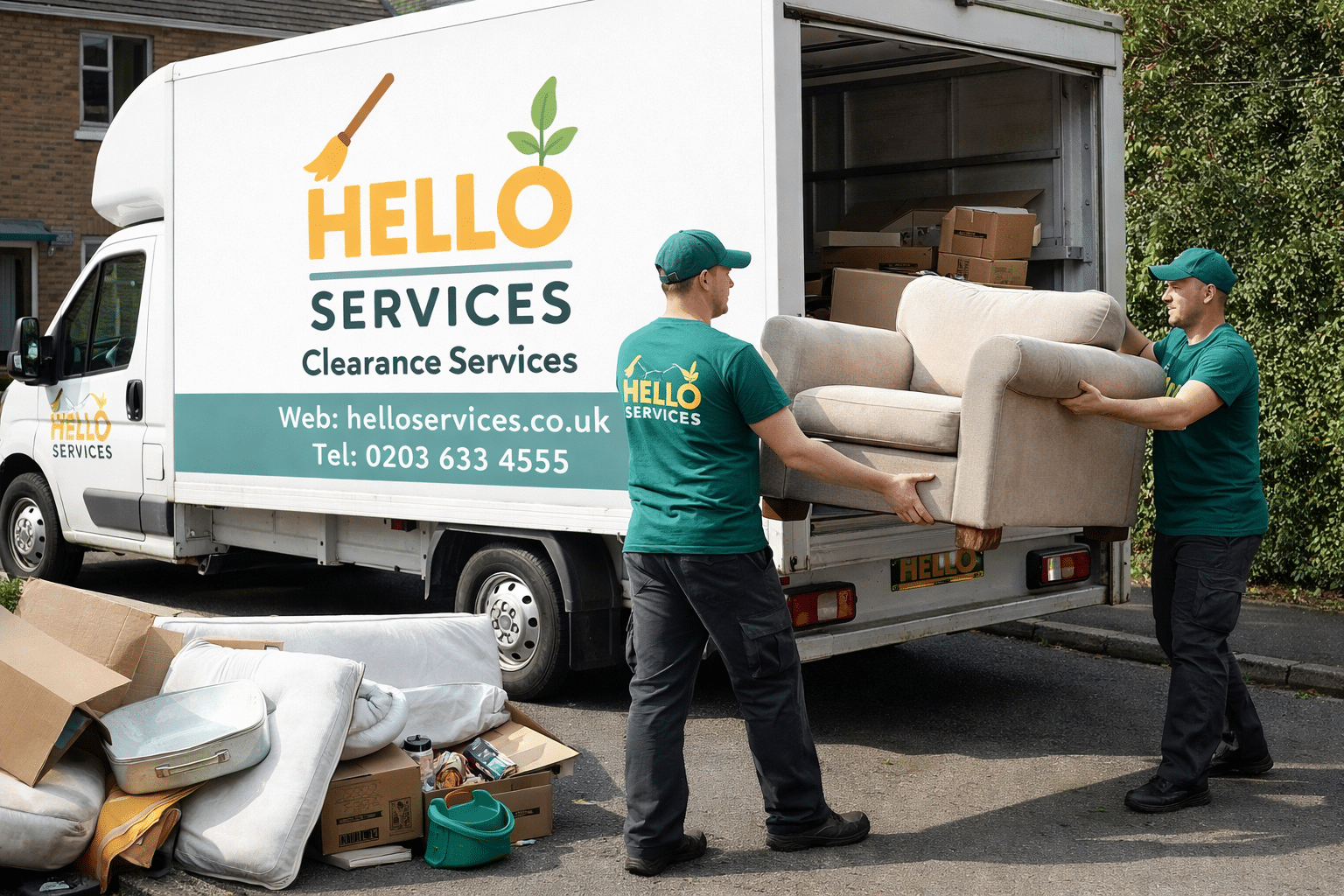
Ask any provider for their reuse policy before you book. If the answer is a shrug, your sofa’s next stop is anyone’s guess.
The law: your waste is your responsibility
Since 2005, householders in England have had a legal duty of care for their waste (section 34(2A), Environmental Protection Act 1990). In plain English: if you hand your waste to someone unlicensed and it gets dumped, you can be penalised — even though you paid in good faith. Councils can issue on-the-spot penalties of up to £600, a magistrates’ court can fine you £5,000, and fines for the fly-tipping offence itself are unlimited.
The good news: protecting yourself takes about five minutes. Every legal waste carrier is registered with the Environment Agency under a licence number starting CBDU — Hello Services included — and you can check any company on the public register, free.
For landlords, agents and businesses the bar is higher still: commercial waste transfer notes must be kept for two years, and from October 2026 Defra’s digital waste tracking service starts replacing paper notes — making the chain of custody for every load visible end to end.
Need a clearance that passes every check on that list? Get a free quote
The fly-tipping problem, in numbers
Fly-tipping isn’t a marginal problem getting better — it’s a mainstream one getting worse. The waste being dumped is overwhelmingly domestic, and it is dumped in exactly the quantities a “cheap man with a van” carries.
Behind the headline sits an enforcement gap. Councils took 572,000 enforcement actions last year, yet only 1,250 cases ended in a court fine. With so few dumpers caught, prevention is your only reliable protection — because when a dumped load is traced, it’s traced to the address on the envelopes in the bags.
“A £40 ‘take it all away’ price usually means one thing: your waste is going somewhere it shouldn’t — with your name still in the bags.”
What it costs in 2026
Clearance is priced by volume, access and item type. Legal disposal has a real cost — transfer station gate fees run roughly £150–£250 per tonne in London — which is why a quote that seems impossibly cheap usually is.
| SERVICE | GUIDE PRICE |
|---|---|
Rubbish removal First cubic yard — roughly a washing machine and a half | £130 |
House clearance Smaller jobs — single rooms, garages, sheds | from £130 |
Man & van One mover, hourly — handy for part-loads and single items | £46/hr |
Full property clearance Whole house or flat, sorted and cleared in one visit | from £590 |
See exact rates for your postcode — no hidden fees. View prices
Four situations, four different jobs
Anything left behind can be billed against your deposit at your landlord’s contractor rates. Clearing before checkout — often paired with an end of tenancy clean — is almost always cheaper.
A clearance-plus-clean turnaround gets a property photo-ready in one visit — and the waste transfer note protects you if a former tenant’s belongings ever resurface where they shouldn’t.
Bereavement and downsizing clearances need patience more than muscle: valuables, documents and sentimental items set aside first, charity donations where possible, and a clear record of what left the property.
Office moves, retail refits and end-of-lease dilapidations mean duty-of-care paperwork, WEEE routes for electricals, and carriers whose licence you’ve verified. Keep the transfer notes for two years.
How to prepare (an hour well spent)
A little preparation makes the day faster, cheaper and calmer — especially for estate clearances, where the sorting is emotional as much as physical.
Choosing a provider: the flags to watch
Hello Services is a registered waste carrier with £1m public liability cover, fixed online quotes and 3,000+ verified reviews — clearance, cleaning, moving and handyman work under one roof, across 200+ UK towns and cities.
Clear it once. Clear it right.
Fixed quotes in minutes, vetted local crews within 24–48 hours, and a paper trail for every load — anywhere in the UK.