
Overview
What Is a Handyman? (And What They Actually Do)
A handyman — or handyperson — is a skilled generalist who handles a wide variety of home maintenance, repair and installation tasks that don’t require a specialist trade. Where a plumber, electrician or gas engineer goes deep into one discipline, a handyman works across many, which makes them ideal for the small, varied jobs that pile up around a home or business.
Typical handyman work includes furniture and flat-pack assembly, TV mounting, hanging shelves, mirrors and pictures, fitting blinds and curtains, putting up flat-pack wardrobes and beds, adjusting sticking doors, resealing baths and showers, minor carpentry, basic plumbing maintenance such as changing a tap washer, filling and touch-up painting, and general odd jobs. The defining feature is breadth: you can hand a handyman a list of unrelated little tasks and have them all ticked off in a single visit — usually far cheaper than booking a separate specialist for each one.
What’s Included in Hello Services’ Handyman Services
Hello Services provides nationwide handyman services across the UK, with 100+ vetted, background-checked professionals covering around 95% of UK urban areas, seven days a week. Every handyman arrives fully equipped with professional tools and standard fixings, and the work is backed by £1 million public liability insurance. The offering is organised into four clear groups:
Assembly Services
Professional building of all furniture brands, including specialist flat-pack and IKEA assembly, wardrobes, beds, outdoor furniture, sheds and complex gym equipment. Flat-pack looks simple until a wardrobe door needs holding square while it’s screwed and anchored to the wall — which is exactly where a second pair of trained hands earns its keep.
Hanging & Mounting
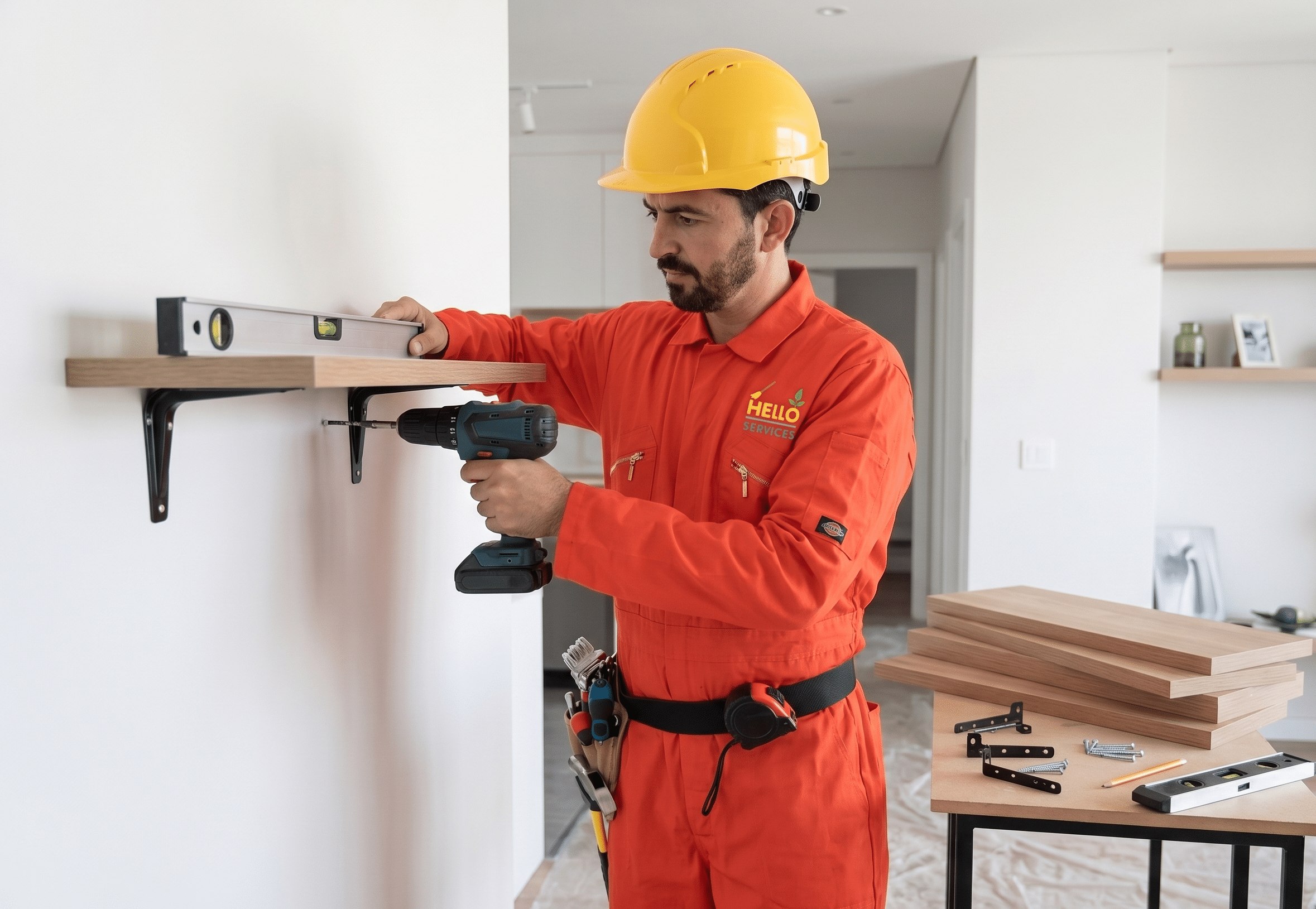
Secure wall work of every kind: TV mounting, shelf installation, mirror and artwork hanging, wallpaper hanging, and blinds and curtain-track fitting — on any wall type, with the right anchors for plasterboard, brick or masonry. This is the category where the wrong fixing (or drilling into a hidden pipe or cable) does real damage, so it pays to use someone who checks first.
Flooring Support
Carpet fitting, wood-flooring help and small flooring repairs and surface fixes — practical support for homeowners and landlords getting a property ready to live in, let or sell.
General Odd Jobs
The miscellaneous list every home generates: mending fixtures, adjusting doors, resealing bathrooms, cat-flap fitting, bath and shower screen fitting, and everyday maintenance tasks. These are the jobs that are too small for a specialist but too fiddly to keep ignoring.
How Much Does a Handyman Cost in the UK? (2026)
Handyman pricing is genuinely variable because “a handyman” can mean anything from a retired joiner doing odd jobs to a multi-skilled maintenance pro. Across the UK, independent handymen commonly charge around £20–£40 per hour, with roughly £30 an hour a fair national average. In London and other major cities, rates rise to about £45–£70 per hour, and a busy first-hour or call-out rate is often higher still. Day rates typically land between £150 and £420 depending on region, with London at the top of that range.
A few pricing mechanics show up almost everywhere and are worth understanding before you book:
- Minimum charge. Most handymen apply a 1–2 hour minimum (or a first-hour call-out fee), so a five-minute job still costs the minimum. This covers travel, parking and setup.
- Labour vs materials. Quoted rates are usually labour only. Materials are either supplied by you or charged on top — though a good handyman can often buy at trade prices and save you the trip.
- Day rates are cheaper per task. Because the call-out cost is fixed, bundling several jobs into one half-day or full-day visit is the single biggest way to cut your per-job price.
- Extras. Evening, weekend and emergency slots often add 15–50%, and city parking, congestion charges or long travel can be passed on.
- VAT. Larger or VAT-registered firms add 20% VAT; many smaller sole traders fall below the threshold and don’t.
For comparison, Hello Services publishes fixed hourly handyman rates with tools and standard fixings included and £1M public liability cover, each with a two-hour minimum:
Handyman Price Guide by Job (UK)
Most homeowners don’t want an hourly rate — they want to know what a specific job costs. These are typical UK 2026 ranges drawn from the major cost guides (Checkatrade, MyBuilder, MyJobQuote, Bark, Taskrabbit and others). Always get a fixed quote for your exact job, as size, access and location all move the price.
| Job | Typical UK cost |
|---|---|
| Flat-pack / furniture assembly | £20–£60/hr, or ~£50–£120 per item |
| IKEA furniture assembly (per item) | £15–£90 depending on size |
| TV wall mounting | £55–£110 (brackets £15–£150 by type) |
| Hanging pictures, mirrors or shelves | £50–£100 per item |
| Curtains & blinds fitting | £60–£120 |
| Minor plumbing (e.g. fixing a leak) | £80–£150 |
| Small electrical (like-for-like light fitting) | £90–£180 |
| Painting & decorating (per room, labour) | £150–£250 |
| Carpentry / door adjustments | £70–£100/hr |
What a Handyman Can — and Can’t — Legally Do in the UK
This is the most important section in this guide, because it protects your home, your insurance and your legal position. There is no single, universal “handyman licence” in the UK. A handyman can legally carry out a wide range of general work — painting, carpentry, furniture assembly, tiling, shelving, minor plumbing maintenance and more — without any formal qualification. But the moment a job crosses into a regulated trade, specific certification becomes the law, regardless of what the person doing it calls themselves.
Gas work — Gas Safe registration is mandatory
Any work on gas appliances, boilers or pipework must be carried out by a Gas Safe registered engineer. This is the one truly universal requirement across all four UK nations, and for good reason: faulty gas work causes carbon monoxide poisoning and explosions. A general handyman must never touch gas unless they personally hold Gas Safe registration.
Electrical work — Part P and “notifiable” jobs
Since 2005, all fixed electrical work in homes in England and Wales must meet Part P of the Building Regulations (Scotland uses the Building Standards system). It is not illegal for a handyman to do minor, non-notifiable electrical work — for example, replacing a light fitting where the wiring stays the same. But notifiable work — installing a new circuit, or any addition or alteration in a “special location” such as a room containing a bath or shower — must be carried out by a registered competent person (NICEIC, NAPIT or ELECSA) or notified to building control before work begins, and certified afterwards.
Legal responsibility sits with you, the homeowner or landlord — you must be able to prove the work meets the regulations, and non-compliance is a criminal offence. Like-for-like swaps are usually fine for a handyman; anything involving new circuits, a consumer unit, gas, or bathrooms needs a registered specialist. A trustworthy handyman will tell you so.
Handyman vs Specialist Tradesperson vs DIY
Choosing the right option saves money and stress. Here’s a simple way to decide.
| Option | Best for | Watch out for |
|---|---|---|
| DIY | Simple, low-risk jobs you’re confident with — basic assembly, filling, touch-up painting. | Hidden pipes/cables when drilling; wonky results; lost time; no insurance. |
| Handyman | A list of small, varied jobs — assembly, mounting, repairs, maintenance — done in one visit. | Confirm insurance; not for gas, new circuits, structural or permit work. |
| Specialist | Regulated or high-value work — gas, rewiring, major plumbing, structural changes, anything certified. | Higher cost; book early; verify registration (Gas Safe, NICEIC). |
A widely used rule of thumb: if a job will take more than a couple of days, cost more than a few hundred pounds a day, or require permits, inspections or certification, hire a specialist. For everything smaller and unregulated, a handyman is almost always faster and cheaper.
How UK Handyman Prices Compare Internationally
Handyman pricing follows the same logic worldwide — hourly or flat-rate, minimum call-out fees, labour separate from materials, and licensed trades (gas, major electrics, structural) carved out for specialists. The headline rates, in local currency, look like this in 2026:
| Country | Typical hourly rate (local currency) |
|---|---|
| United Kingdom | £20–£70/hr (≈ £30 national average; higher in London) |
| United States | $50–$150/hr (typical job ≈ $164–$649) |
| Australia | AUD $40–$150/hr (odd jobs $40–$60; specialist $70–$150) |
| Canada | CAD $60–$120/hr (up to ~$175 for specialised work) |
These aren’t direct currency conversions — they reflect each local market — but the pattern is consistent. One genuine cultural difference worth knowing: tipping a handyman is normal in the US (commonly $10–$50 for good work), whereas in the UK it isn’t expected. Here, the most valued “tip” is a positive review and a referral.
How to Hire a Reliable Handyman: A Practical Checklist
Trade directories vet businesses to varying degrees, but the responsibility to check still sits with you. Use this checklist before you book:
- Public liability insurance. Non-negotiable — typically £1m–£5m of cover for damage or injury during the work. Ask to see it; reputable firms expect the question. (Hello Services carries £1M as standard.)
- The right registration for regulated work. Gas Safe Register for gas; a registered electrician (NICEIC/NAPIT/ELECSA) for notifiable electrics; and TrustMark — the only government-endorsed scheme — for broad home-improvement reassurance.
- Reviews across more than one platform. Cross-check Google, Trustpilot, Checkatrade, MyBuilder or Rated People rather than a single source.
- Get it in writing. A clear quote stating what’s included (labour, materials, call-out, VAT) protects you under the Consumer Rights Act 2015.
- Compare quotes. Two or three for jobs over a couple of hundred pounds.
- Mind the red flags. Cash-only demands, full payment up front, vague quotes, “today only” pressure, and anyone touting for work on your doorstep.
How to Get the Best Value From a Handyman
A few simple habits noticeably reduce your bill:
- Bundle your jobs. Write a full to-do list and book one half-day or full-day visit — you pay the call-out once and the per-task cost drops sharply.
- Clear the space first. Move furniture and clutter so the handyman can start straight away.
- Have materials ready. Buying your own fixings, paint or fittings (confirming specs first) avoids supplier mark-ups.
- Avoid premium slots. Weekday and off-peak bookings dodge evening and weekend surcharges.
- Be specific. Send photos and clear descriptions so the quote is accurate and there are no surprises on the day.
Frequently Asked Questions
Furniture and flat-pack assembly, TV mounting, hanging shelves, mirrors and pictures, fitting blinds and curtains, minor repairs, adjusting doors, resealing baths, basic plumbing maintenance, touch-up painting and general odd jobs. They can’t legally do gas work (Gas Safe only) or notifiable electrical work (registered electrician only).
Around £20–£40 per hour nationally (≈£30 average), rising to roughly £45–£70 in London and major cities, usually with a 1–2 hour minimum. Day rates run from about £150 to £420 depending on region.
No tools — a professional handyman arrives fully equipped. Materials are usually either supplied by you or charged separately; many handymen can buy at trade prices on your behalf.
Only within limits. Minor like-for-like electrical jobs (e.g. swapping a light fitting with the wiring unchanged) are allowed, but notifiable work must be done by a registered electrician under Part P. Any gas work must be done by a Gas Safe registered engineer — never an unregistered handyman.
For small, varied, unregulated jobs, yes — usually much cheaper, especially when you bundle several tasks into one visit. For regulated, complex or high-value work needing certification or a warranty, a specialist is the right (and legally required) choice.
It isn’t expected in the UK, unlike in the US. A good review and a referral are the most appreciated thank-you.
Often, yes — subject to your postcode and availability. Hello Services has local professionals across most UK urban areas seven days a week.
Clear Your To-Do List in One Visit
From flat-pack and IKEA assembly to TV mounting, shelves, blinds, carpentry and a long list of odd jobs, a good handyman sorts it all in a single insured visit. Hello Services covers the UK nationwide, seven days a week, with vetted pros, fixed hourly rates and £1M public liability cover.
Prices are typical 2026 ranges and vary by job, access and location; always get a written quote. This is general information, not legal advice.
Sources & Further Reading
Built from 38 UK and 18 international sources spanning pricing, regulation, trade bodies and global comparison.
UK handyman pricing
- MyBuilder — Handyman Hourly Rates
- Checkatrade — IKEA Assembly Cost
- Checkatrade — TV Mount Cost
- Checkatrade — Flat Pack Assembly
- Taskrabbit UK — Cost Guide
- Airtasker UK — Handyman Cost
- PriceYourJob — Handyman Prices
- PriceYourJob — Furniture Assembly
- MyJobQuote — Flat Pack Furniture
- MyJobQuote — TV Wall Mount
- MyBuilder — Flat Pack Assembly Cost
- Bark — TV Mounting Cost
- HandyExperts — Hourly Rate
- Handyy — Cost Per Hour
- UK Startup Magazine — Self-Employed Rates
- Handyman Service London — London Guide
- Kensington Maintenance — London Rates
- Screwdriver Flatpack — Pricing
- Furniture Assembly Services — Pricing
UK regulation & safety
UK trade bodies, vetting & insurance
- Age UK — Finding a Tradesperson
- Elec.Training — Trade Directories
- Electrician Courses 4U — Trusted Schemes
- Privyr — UK Platforms & TrustMark
- SimplyQuote — Handyman Insurance
- Radius — Handyman Insurance
- Tradesman Saver — Public Liability
- Kael Tripton — Public Liability
- Marsh Commercial — Handyman Insurance
International comparison
- Angi (US) — Handyman Cost
- Thumbtack (US) — Handyman Prices
- HomeAdvisor (US) — Price List
- Housecall Pro (US) — Pricing Guide
- AllBetter (US) — Hourly Rates
- Setup NYC (US) — Hourly Rate
- Airtasker (AU) — Handyman Cost
- Call The Handyman (AU) — Rates
- Mates Rates (AU) — Cost
- HomeStars (CA) — Cost Guide
- HomeStars (CA) — Toronto
- WhatCosts — Global Comparison