
Part of the complete guide to hanging mirrors and artwork.
Step 4: work out the height (the bit most people guess)
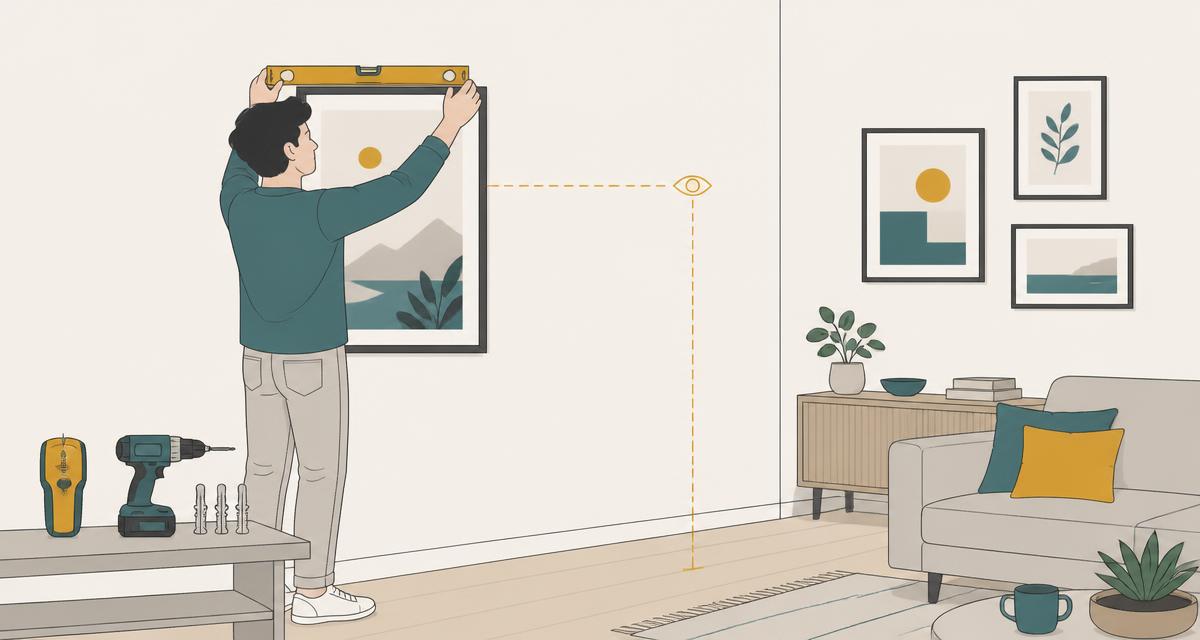
Galleries and museums hang to a centre line of roughly 150 cm from the floor, because that is average standing eye level. Domestic rooms follow the same rule with one exception: when a piece sits above furniture, the furniture — not the floor — sets the reference.
The formula
You are not marking where the frame goes; you are marking where the fixing goes. Work it out like this:
- Halve the frame heightA 90 cm tall frame is 45 cm from its centre to its top edge.
- Add it to your centre height150 cm centre + 45 cm = 195 cm, which is where the top of the frame will sit.
- Measure the dropWith the cord or D-ring pulled taut, measure from the top of the frame down to the hook point — say 10 cm.
- Subtract the drop195 cm − 10 cm = 185 cm. That is your pencil mark for the hook, not 150 cm.
Interactive tool
Hanging-height calculator
Enter your piece and the situation. The calculator works the formula for you and gives the one number you actually mark on the wall: the hook height.
Gallery standard: the middle of the piece sits at average standing eye level.
Overall height of the mirror or frame, top to bottom.
With the cord or D-ring pulled taut, the distance from the top of the frame down to the hook point.
Mark your hook at
185 cm
Measured from the finished floor, straight up the wall. Centre line at 150 cm from the floor.
- Top of frame
- 195 cm
- Centre of piece
- 150 cm
- Bottom of frame
- 105 cm
Figures are guidance for typical UK rooms with 2.4 m ceilings. Always confirm the fixing suits your wall type and that the load stays under half the anchor's rated capacity.
| Situation | Target | Why |
|---|---|---|
| Clear wall, standing room | Centre at 145–152 cm | Sits at eye level for most adults |
| Above a sofa | 15–25 cm gap above the back | Any more and the piece floats; any less and it looks jammed |
| Above a console or sideboard | 15–20 cm gap | Ties the piece to the furniture below it |
| Above a bed | 20–25 cm above the headboard | Keep it light — see the safety note |
| Dining room, seated view | Centre at 135–145 cm | Seated eye level is lower |
| Stairwell | Centre 150 cm above the nose of each tread | Follows the rake so the run reads straight |
| Hallway full-length mirror | Top at 175–185 cm | Full head-to-toe reflection for most heights |
| Above a fireplace | 10–15 cm above the mantel | Check heat and soot exposure before hanging art |
Planning a gallery wall without swiss-cheesing the plaster
A gallery wall lives or dies on the layout, and the layout should be finished before any drill comes out of the box. Do it on the floor.
- Measure the wall and mark it out on the floorUse masking tape on the carpet to mark the exact width and height of the usable wall area, including the sofa line if there is one.
- Arrange inside the tapeStart with the largest piece slightly off-centre, then balance around it. Keep 5–8 cm between frames — consistent gaps read as deliberate, varied ones read as accidental.
- Photograph the layoutA phone photo from directly above is your reference for the rest of the job, and it is far easier to critique than the arrangement itself.
- Make paper templatesDraw round each frame on newspaper or lining paper, cut out, and mark the hook position on each template.
- Tape the templates to the wallReposition freely until it looks right, checking the group's overall centre sits near 150 cm. Live with it for a day if you are unsure.
- Drill through the templateDrill straight through the marked hook point, then tear the paper away. Every hole lands exactly where you planned it.
Layout rules that hold up
- Treat the whole group as one rectangle and centre that rectangle, not each individual frame.
- Grids need identical frames and identical gaps; salon-style hangs need varied sizes but one shared alignment line.
- An odd number of pieces almost always looks more natural than an even number.
- Above a sofa, the group should span roughly two thirds to three quarters of the sofa's width.
- Repeat one element — frame colour, mount width or palette — so mixed sizes still read as a set.
- Hang the bottom row first and work upwards; errors compound less that way.